
Study of the Quran Majid


Lesson 5
Study of the Quran Majid
The Quran Majid is the message of Allah, Kalam Ullah. Kalam means message. It is the latest Asmani Kitab which Allah Ta’ala revealed to the Great Prophet (SM). It is the best scripture of mankind and a complete way of life.
The entire Quran was revealed for a long period of twenty-three years. The first verse of the Quran was revealed on 22nd December, 609 AD when the Great Prophet (SM) was 40 years old and the revelation ended in the year 632 AD, the year of his death.
The language of Quran Majid is Arabic. The Quran has a total of 30 paras or chapters. There is a total of 114 suras. The number of verses is 6,236. Although the suras are of different sizes, the paras of the Quran are almost the same size. The biggest sura of the Quran Majid is Sura Baqarah. Its number of verses is 286. The smallest sura is Surah Kausar. Its number of verses is 3.
Fourteen hundred years have passed but the Holy Quran remains unchanged and shall remain unchanged forever. No change has been made so far since it was revealed to our great prophet (SM) and no change would be made in future. Because Allah Ta'la Himself has taken the responsibility of preserving this Quran. Allah says, “I have revealed the glorious Quran and I am its custodian too.” (Sura Hijr)
There are four aims in the recitation of the Quran:
1. To recite correctly
2. To understand its meaning
3. To do the biddings of the Quran
4. To refrain from what He has forbidden
We have to learn to recite the Quran with proper pronunciation. If the Quran is recited with correct pronunciation, the meaning of the word is correct. If the Quran is pronounced rightly and properly, the meaning of Kalam is correct. Salat is correct. On the other hand, the meaning becomes changed if the Quran is not recited correctly. Salat is not correct. That is why we shall learn to recite the Quran Majid correctly and teach others to read it correctly. We shall act according to the sayings of the Quran Majid.
Harkat
The vowels that are used to pronounce Arabic words are called Harkat.
There are three kinds of Harkat, such as- Jabor  , Jer
, Jer  , Pesh
  ।
।
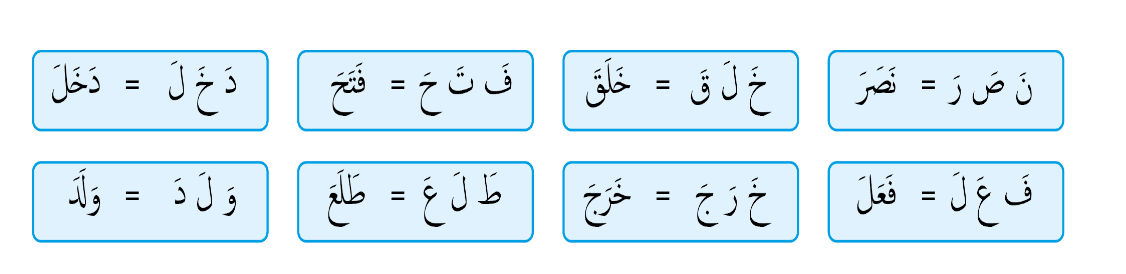
1) When Jabor is written on any letter it is pronounced as ‘aa’.
Such as: ﻛَﺘَﺐَ Kaf jabar ka, Ta jabar ta, Ba jabar ba = Kataba
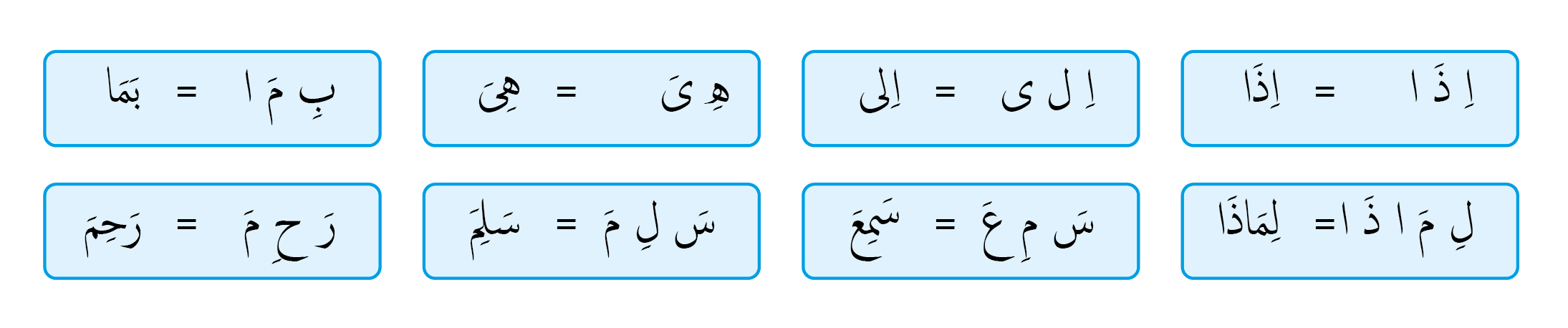
2) When Jer is given under any letter it is pronounced as ‘ee’.
Such as: ﻛِﻨَﺎ Kaf jer ki, Nun alif jabar na = kina
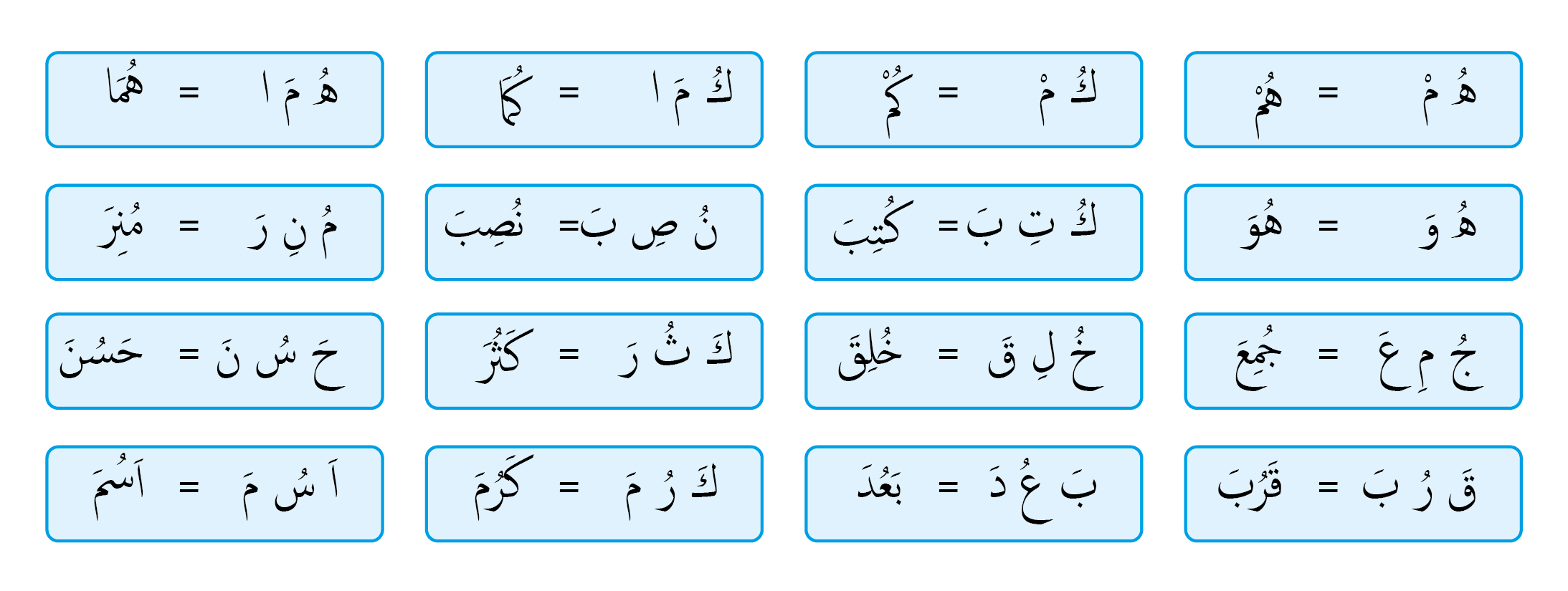
3) When Pesh is given on any letter it is pronounced as ‘u’.
Such as: ﻛُﺘِﺐَ Kaf pesh ku, ta jer ti, ba jabar ba = kutiba
Tanbeen
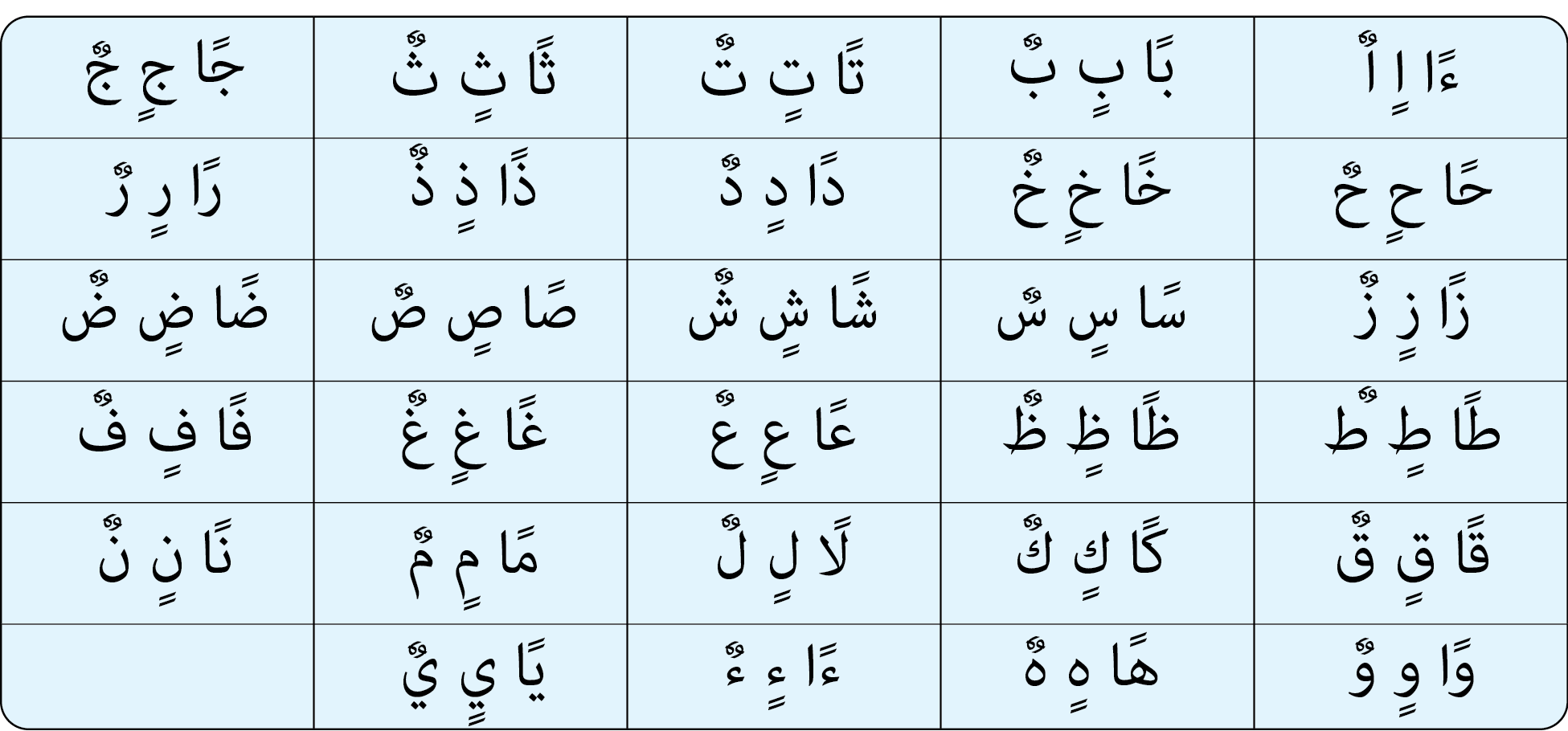
Double Jabor ( ), Double Jer (
 ) and Double Pesh (
 ) are called Tanbeen.
Tanbeen will be pronounced with nun.
Read and write down the following chart by pronouncing Double Jabor (), Double Jer (), and Double Pesh () together.
Jazam
There are many letters in Arabic which do not have Jabor, Jer or Pesh. But the previous letters have Jabor, Jer or Pesh. A symbol is used to pronounce this letter. This sign is called Jazam.
Another name of Jazam is Sakin.
Jazam or Sakin is expressed by three symbols. Such as - 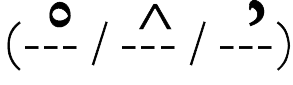
Example: اَﻝٛ Alif lam Jabar = al
ﺑِﯽٛ Ba ya Jer = Bi
ﻗُﻦٛ Qaf Nun Pesh = Qun
So, if there is Jazam or Sakin on any letter, it has to be pronounced together with the previous letter.
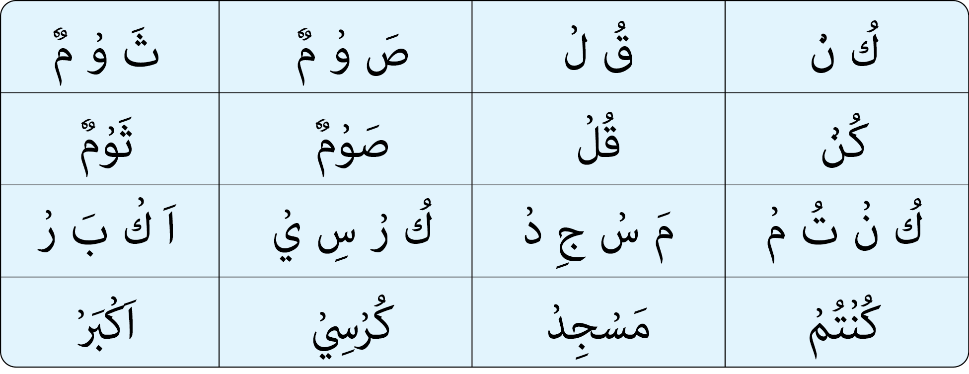
Read and write down the following chart with Jazam.
Tashdeed
The letter which is pronounced twice being at the same place is called tashdeed.
Tashdeed looks like the head of the letter Seen ( ).
).
Pronunciation of Tashdeed:
1. Letters with Tashdeed are pronounced twice.
2. At first, with the Harkat on the right and the second time, with the Harkat of its own.
Example: ﺍﻥَّ ﻥَ = + ﺍَﻥْ = Alif Nun Zabor An, Nun Zabor Na = Anna
ﺭَﺏَّ = ﺏْ + ﺭَﺏْ = Ra Ba Zabor Rab, Ba Zabor Ba = Rabba
Read and write the following chart with tashdeed.
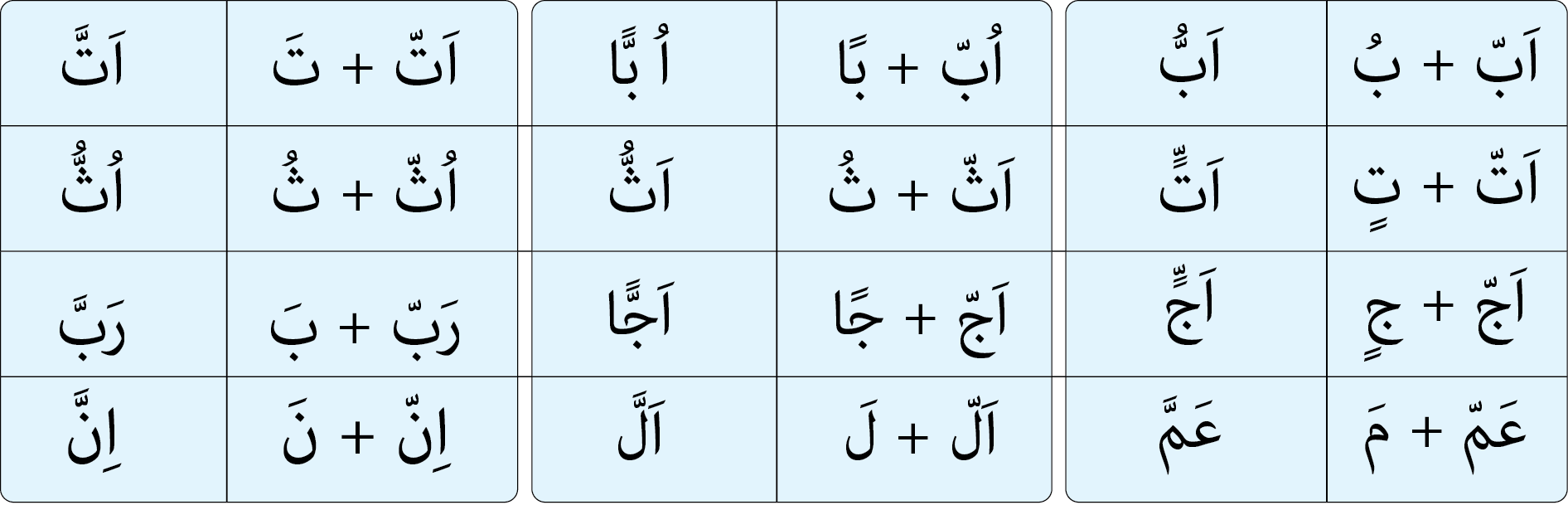
Jer of letters with Tashdeed can be positioned both below the letter and below the Tashdeed. For example:

Madd
There are some Haraf or letters in Arabic language, which are to be read in short breath. On the other hand many letters are tobe read in long breath. To read in long breath is called Madd.
There are three types of Madd.
Such as: 1 Alif Madd, 3 Alif Madd, 4 Alif Madd.
According to some experienced Qari, at least 1 second is requied to read 1 Alif Madd.
1 Alif Madd:
To read in little long breath like the time of reading 1 Alif is called 1 Alif Madd.
There are three letters for 1 Alif Madd. They are: ى , و , ا . Signs of Madd are used with these three letters. If there is only – ا (‘Alif’ without Jabor, Jer, Pesh etc.) and there is a Jabor on its right hand side, if there is a Pesh on the right hand side of و (Wao Sakin), and a Jer on the right hand side letters of ى (Yea Sakin), Madd is applied. Such as: بَا بُوْ بِي
1 Alif Madd has also other sign. Such as:
1. Jabar in the erect position on a letter - 
If there is a sign like এon a letter, it is to be read in a little long accent like the time of reading 1 Alif.
For example: ﻃٰﻪٰ = twa with erect jabar ta, ha with erect jabar ha = Ta-ha-
2. Erect Jer 
If there is a sign like under a letter, it is to be read in a little long accent like the time of reading 1 Alif.
For example: ﺑِﻪٖ = Ba jer bi, ha with erect jer hii = bithii
3. Reverse Pesh 
We know that pesh is like this . But reverse pesh is written like this
If there is any reverse pesh on a letter, it is to be read in a little long accent like the time of reading 1 Alif.
For example: ﻟَﻪٗ = Lam jabar la, ha with reverse pesh hu = Lahu
3 Alif Madd:
To read in long breath like the time of reading 3 Alif is called 3 Alif Madd.
Sign of 3 Alif Madd - 
If there is a sign like on a letter, it is to be read in a long accent like the time of reading 3 Alif.
For example: ﻛَﻤَﺎۤ = Kama---
4 Alif Madd:
To read in longer breath like the time of reading 4 Alif is called 4 Alif Madd.
Sign of 4 Alif Madd - 
If there is a sign like on a letter, it is to be read in a longer accent like the time of reading 4 Alif.
For example: 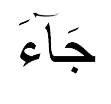 = Ja - - - - Aa