
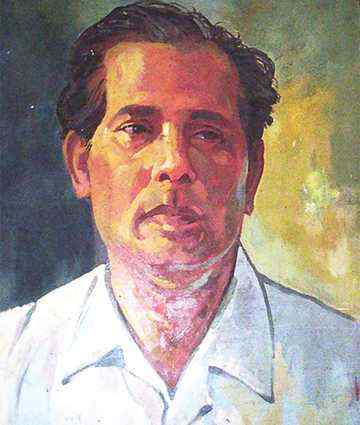
Zainul Abedin, the great artist


 Activities
A. Read the text and answer the questions that follow.
The pioneer of Bangladeshi modern art Zainul Abedin is widely acclaimed for his Bengal 'Famine Sketches'. Through the series of sketches, Zainul not only documented the harsh famine of 1943 but also showed its sinister face through the skeletal figures of the people destined to die of starvation in a manmade plight. He depicted these extremely shocking pictures with human compassion. He made his own ink by burning charcoal and used cheap ordinary packing paper for sketching. Using the ink and applying the brush where necessary, he produced the drawings and sketches which later became iconic images of human suffering.
Zainul developed a knack for drawing and painting when he was a high school student. After completing high school, he took admission in the Government School of Art, Calcutta (now Kolkata). He graduated with the first position in first class in 1938. He was appointed a teacher of the Art School while he was still a student there. He also attended the Slade School of Arts, London during 1951-52.
Zainul Abedin is considered the founding father of Bangladeshi art. He was an artist of outstanding talent and earned international reputation. For his artistic and visionary qualities, he is referred to as Shilpacharya meaning 'great teacher of art' in Bangladesh. He was the first Principal of the first art school in Dhaka in East Pakistan (now Bangladesh). He organized the Nabanna (harvest) exhibition in 1969. The exhibition included a 65 feet long scroll portraying the rural East Pakistan in phases from abundance to poverty. This intensified the already heightened non-cooperation movement against the Pakistan regime. The exhibition was symbolic of the Bangalee artists' protest and a milestone in our struggle for cultural and political freedom. Zainul's dynamic style of work is evident in a 30 feet long scroll painting called Manpura, which was done to commemorate the death of hundreds and thousands of people in the devastating cyclone of 1970.
He designed the pages of the Constitution of the Bangladesh. He founded the Folk Art Museum at Sonargaon, and also Zainul Abedin Shangrahasala, a gallery of his own works in Mymensingh in 1975.
The river Brahmaputra played a vital role in his paintings and was a source of inspiration all through his career. Much of his childhood was spent near the scenic river Brahmaputra. A series of water colours that Zainul did as his tribute to the river earned him the Governor's Gold Medal in an all-India exhibition in 1938. This was the first time that he came into spotlight and this award gave him the confidence to create his own visual style. Zainul Abedin was born in Kishoreganj on 29 December 1914 and died in Dhaka on 28 May 1976.
Questions
C. Listen to the Audio and tick the word/s you hear.
1. The US Ambassador to Bangladesh considered Zainul Abedin a
2. Zainul's art gallery was set up in --
3. The number of Zainul's artworks preserved in the gallery is -—
4. The US Ambassador commented that the museum is a global a
5. The US Ambassador was in the gallery for
D. Listen to the text again and answer the questions.